
Owns and operates Westech Automotive, Inc., a machine shop and vehicle repair service business located in Silver Lake, WI.
Mismatched components lead to added stress and very expensive comebacks
Pull a cylinder head from n engine and what do you see? If you answered "the head, valves, seats, springs, guides and retainers", you are wrong. Instead of individual parts, you're looking at the engine's valve control system.
Obviously, since the first four-cycle internal combustion engine, these parts have always worked together. However, the old term "valvetrain" was a good description of the relationship among the components. The individual parts were essentially coupled like cars on a train with the camshaft working as the train's engine to keep everything moving. Unless you made a drastic change, such as putting in a full competition camshaft without doing anything else to the head or engine, changing parts was like switching cars on a train. After everything was coupled together again, the train was ready to go.
In modern engines, specification and tolerances are tighter than ever before. The relationship among the parts is truly a system. Change anything from OE specification and you change the entire system. Sometimes the overall change is minor, but other times your modification causes major repercussions.
Change the system
Once you make a change from OE spec, you will be married to that change for as long as that engine is in use. No one is saying you can't change the original valve system components or specifications. However, before you make a change, either by parts replacement or machining, you have to ask yourself what's going to happen to the system. If you don't ask this question, you can be unpleasantly surprised by unexpected wear or other performance problems.
As an engineer with one of the leading valve manufacturing companies put it, "any change modified the whole system". All the components in the system must be matched to maintain emissions control, performance, fuel economy and longevity. I you can only change one component, you may introduce added stress in the system. Added stress always goes to the weakest point of the system and causes rapid wear or other problems at that point.
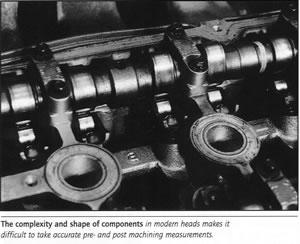
Heads are so sensitive that routine machining practices are no longer routine. On the Chrysler 2.0L, 4-valve, DOHC heads, the company requires that a torque plate and the rocker arm assembly be installed before doing any valve work. The torque plate must be at least ½" thick. Although using torque plates has been a standard practice for many years when doing block work, they may now be needed for heads as well.
Surprisingly, changes not directly involving the valve control system can cause problems. Recently, one of the major automakers, during pre-production engine testing, changed the ECM programming to reduce emissions. After the change, durability testing showed accelerated valve seat wear. The computer had to be reprogrammed again to keep the improved emission control, but avoid the valve seat wear problem.
 Next Page